

Anchor points
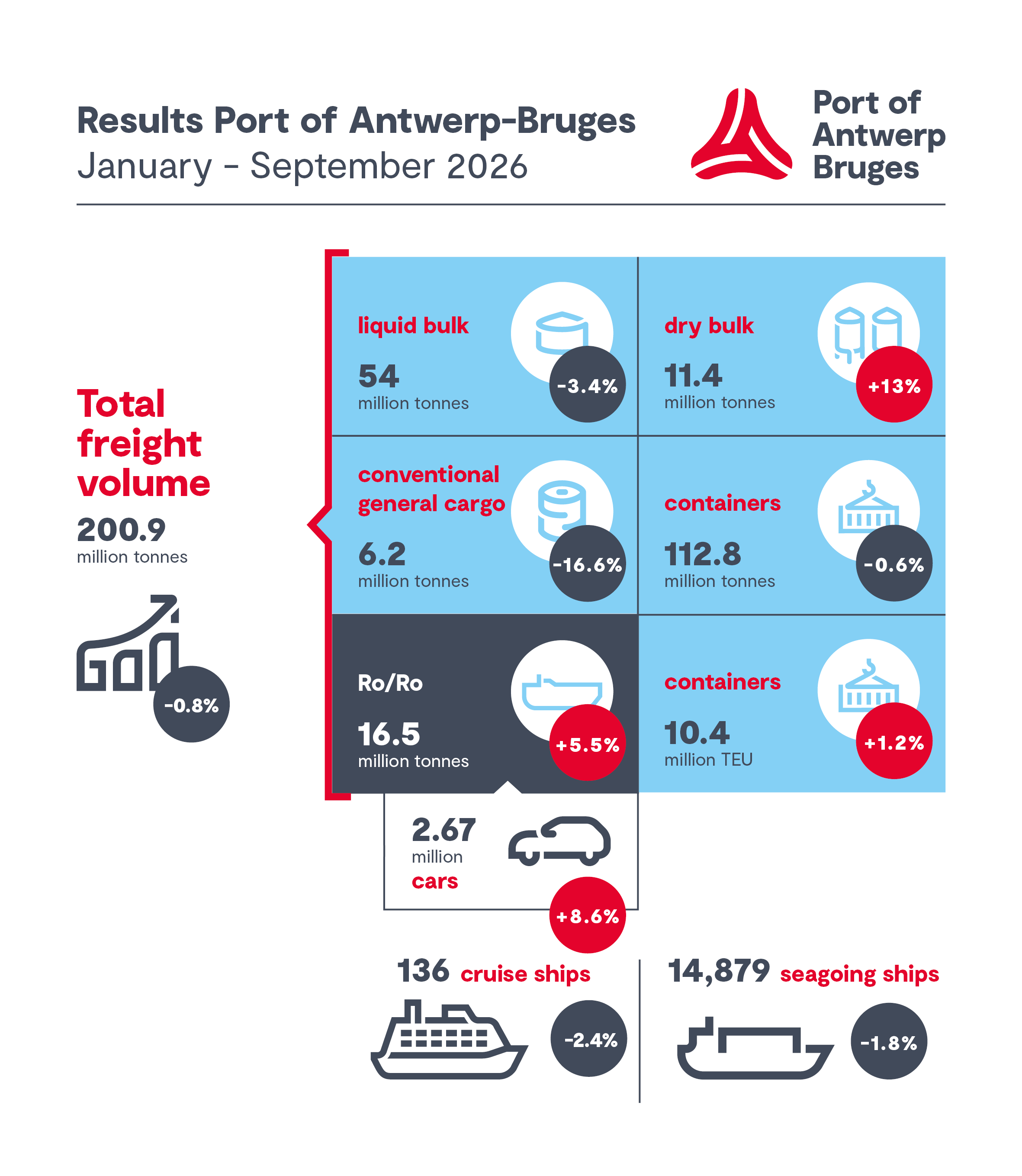
- Total throughput is down 0.8% in the first nine months of 2026.
- Container throughput rose by 1.2% in TEUs following the strongest container quarter since late 2020.
- RoRo and dry bulk grew, while conventional general cargo and liquid bulk declined.
Clear recovery in container traffic in third quarter
After a first half of the year in which shipping was affected by adverse weather conditions, strikes in the nautical chain, and an oil spill in the Deurganck Dock, the start of the third quarter was also disrupted. In mid-July, a damaged container carrying hydrofluoric acid disrupted operations in the Deurganck Dock.
From August onwards, the trend reversed. The subsequent strong volumes led to the best performance since the fourth quarter of 2020. As a result, container throughput grew by 1.2% in TEUs over the first nine months. In tonnage, volume remained 0.6% below last year's level. The growth was concentrated in empty containers (+11.7% in TEUs), while the throughput of full containers dropped by 1.3%. Rising import volumes and pressure on exports are increasing the imbalance and the need to reposition empty containers, particularly towards Asia.
The ongoing conflict in the Middle East also continues to impact cargo flows. Since March, no LNG cargoes from Qatar have arrived, and since mid-May, diesel supplies from the Middle East have also come to a halt. Container shipping lines adjusted their sailing schedules and developed alternative routes to serve the region. As a result, container exports to the Persian Gulf fell by 70%, while those to other parts of the Middle East nearly quintupled.
Rob Smeets, CEO Port of Antwerp-Bruges: “The strong recovery of container throughput in the third quarter shows the resilience of Port of Antwerp-Bruges. Simultaneously, the operational context remains challenging. Trade barriers, high energy prices, and a weak European industrial sector are putting pressure on several cargo flows. That is why we need to keep investing in efficiency, capacity, and competitiveness so that Port of Antwerp-Bruges can continue to serve as a logistical and industrial powerhouse in a volatile context.
”
Johan Klaps, Chairman of the Board of Directors of Port of Antwerp-Bruges and Port Alderman for Antwerp: “Geopolitical tensions and trade conflicts are increasingly dictating global cargo flows. This makes it essential to diversify our trade relations and tap into new growth markets. India presents significant potential in this regard. The EU free trade agreement has the potential to deliver a further impetus to trade volumes. Port of Antwerp-Bruges intends to leverage these opportunities to reinforce its position as a primary gateway connecting India and Europe.
”
Dirk De fauw, Vice President of the Board of Directors of Port of Antwerp-Bruges and Mayor of Bruges: “These results highlight the extent to which global developments resonate directly within our ports. Energy streams are realigning, trade routes are adapting, and markets are swiftly evolving. The key strength of Port of Antwerp-Bruges is that, operating from both Antwerp and Zeebrugge, we can accommodate a broad spectrum of cargo flows. This complementarity ensures our resilience in an ever-shifting global landscape.
”
Divergent trends across other cargo flows
Liquid bulk remained under pressure and dropped again from June, with lower volumes of petroleum derivatives, chemicals, and LNG. Weak European industrial demand and high energy prices remain key challenges in this context.
Conventional general cargo throughput dropped by 16.6%, primarily due to the decline in iron and steel (-17.5%). European steel quotas, CBAM, high energy costs, and weak demand weigh on the market. By contrast, fruit and vegetables showed growth (+7.6%).
RoRo throughput grew by 5.5%, mainly due to strong growth in new cars (+9.3%), particularly from China and Japan. Cargo flows with Ireland and Scandinavia saw an increase, in contrast to falling volumes with the United Kingdom and the Iberian Peninsula. Dry bulk also recorded a 13% growth, mainly thanks to higher volumes of iron ore and other ores. Fertilisers, on the other hand, fell by 1.1%.
View the detailed quarterly figures